


Your shopping cart is empty!
Tomato "Gregory Altai"

Eco seeds

Tomato "Grégory Altaï".
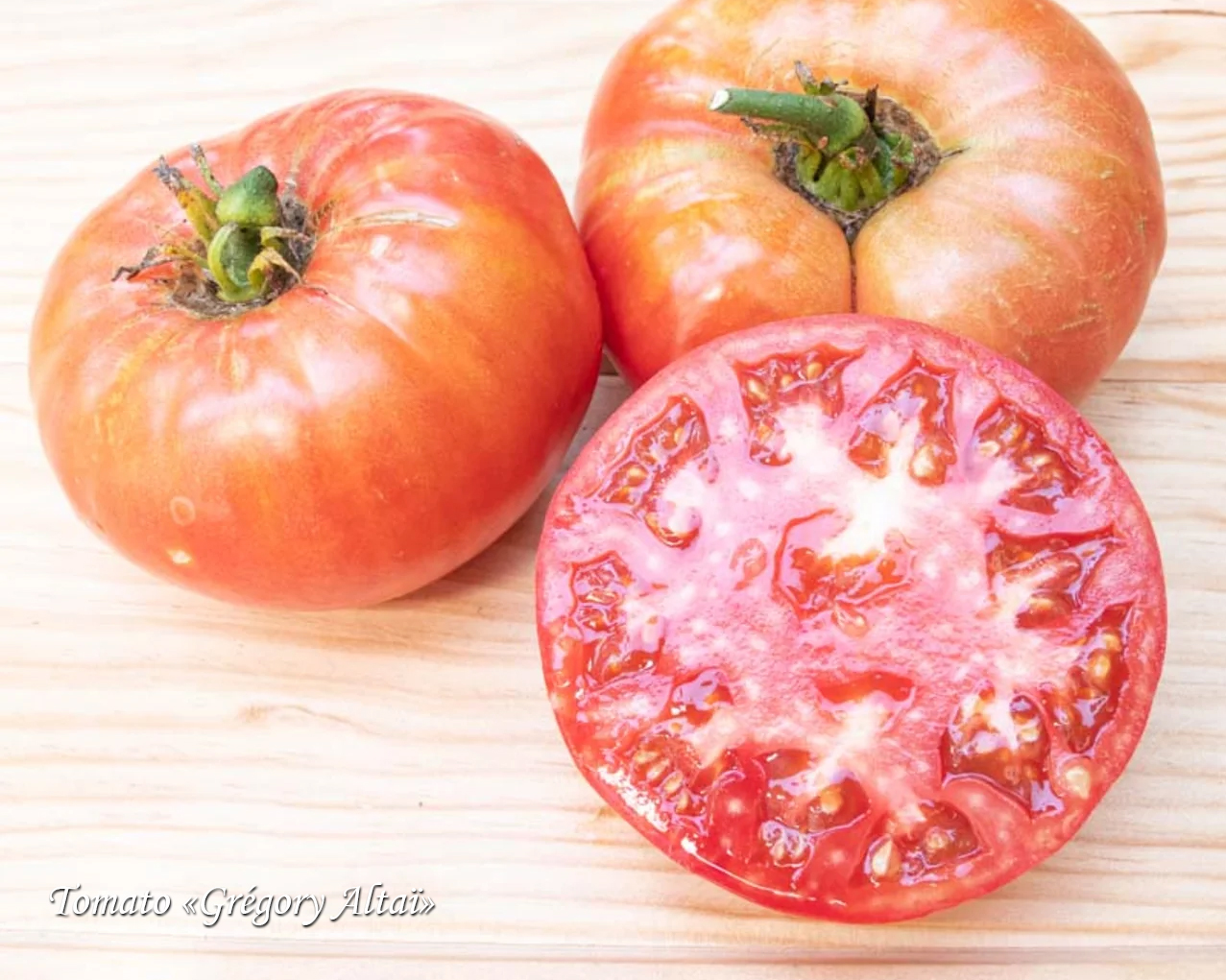
This outstanding early-maturing Siberian beefsteak variety yields large pinkish-purple fruits weighing from 200 to 500 g with a superb sweet flavor. Their dense, firm core and meaty texture allow the tomatoes to be sliced very thinly and evenly.
Characteristics:
Maturity: Early
Weight: 200–500 g
Shape: Flattened (oblate)
Texture: Meaty
Growth Type: Indeterminate
Color: Pink
Plant Height: up to 200 cm
Foliage: Regular
Historical Reference: This established heirloom variety originates from the Altai Mountains — a picturesque mountainous region in southern Siberia, located near the border with China.
This outstanding early-maturing Siberian beefsteak variety yields large pinkish-purple fruits weighing from 200 to 500 g with a superb sweet flavor. Their dense, firm core and meaty texture allow the tomatoes to be sliced very thinly and evenly.
Characteristics:
Maturity: Early
Weight: 200–500 g
Shape: Flattened (oblate)
Texture: Meaty
Growth Type: Indeterminate
Color: Pink
Plant Height: up to 200 cm
Foliage: Regular
Historical Reference: This established heirloom variety originates from the Altai Mountains — a picturesque mountainous region in southern Siberia, located near the border with China.
* Recommendations for Growing Tomatoes in Open Ground.
The tomato belongs to the nightshade family (Solanaceae). It is an annual herbaceous plant (under favorable tropical conditions, it acts as a perennial). When seeds are sown directly into the ground, it forms a deep taproot penetrating up to 1.5-2.5 m, whereas transplanted seedlings develop a robust fibrous root system reaching 50-70 cm deep. The tomato is very heat-loving. Seeds of most varieties begin to germinate at +10...+15°C, but the optimal germination temperature is +22...+25°C. If the temperature drops to +13...+15°C, the flower buds fail to open and blossoms drop, while at +10°C, plant growth stops completely. Light frosts (-1 to -2°C) are fatal to most varieties, and very slight frosts (-0.5 to -0.8°C) may kill only the flowers and young fruits.
The tomato is resistant to dry air. This is due to its strong and well-developed root system. For normal plant growth and development, the optimal air humidity is 70-80%.
Compared to other vegetable crops, the tomato is less demanding regarding soil fertility. The highest yields are obtained on light, well-structured, easily warmed soils rich in organic matter.
As a light-loving crop, the tomato thrives under prolonged, intensive sunlight. In low light, carbon dioxide assimilation slows down, and plant growth and development are significantly delayed. They are highly demanding regarding light intensity.
Cultivation.
The high productivity and early fruiting of tomatoes depend directly on their growing conditions. Elevated temperatures, good lighting, and optimal watering are the main factors determining plant growth, development, ripening rates, and productivity. The best soils for growing tomatoes are loose, moisture-retentive soils rich in organic matter with a neutral or slightly acidic reaction (pH around 6.5).
Preceding crops: winter crops, turned-over perennial grasses, legumes, early and cauliflower, cucumbers, onions. When growing tomatoes without seedlings (direct sowing), planting is done when the soil has stably warmed to +10...+12°C at a depth of 5-6 cm.
When using the transplant method, seedlings are planted outdoors when the threat of late spring frosts has completely passed. Planting density: 4-10 plants per 1 m² (depending on the variety's growth vigor and growing conditions).
Seed consumption is 0.2-0.25 kg per hectare for the transplant method and 0.5-1.0 kg per hectare for direct sowing.
Tomatoes extract many nutrients from the soil to produce a harvest and consume a large amount of water during fruit filling; however, they are relatively drought-resistant and absolutely cannot tolerate waterlogging.
When applying fertilizers, remember that fresh organic fertilizers (manure) should be applied to the preceding crop. For mineral top-dressing, the potassium rate should exceed the nitrogen rate by 2-2.5 times. Typically, 10-15 kg of humus (compost), 50-60 g of nitrogen and phosphate fertilizers, and 80-100 g of potassium fertilizers are applied per 1 m². Excessively high doses of nitrogen fertilizers cause vigorous foliage growth at the expense of fruit and make the plants leggy.
Growing high-quality seedlings is extremely important; sowing begins 60-65 days before planting out. Peat or plastic pots should be 10x10 or 8x8 cm in size. The seeding depth is 1-2 cm.
At a temperature of +20...+25°C, seedlings usually emerge on the 5th-6th day. After that, the temperature should be lowered to +17...+18°C during the day and +12...+14°C at night to prevent the seedlings from stretching.
Pricked-out seedlings are shaded from direct sunlight for 2-3 days, and during the first week, a temperature of +20...+22°C is maintained, or +15...+16°C in cloudy weather.
Water the seedlings as needed, infrequently but thoroughly. 10-12 days before planting in open ground, the seedlings are hardened off by gradually lowering the day and night temperatures and exposing them to fresh air.
When planting in the garden bed, the roots should be covered with soil up to the cotyledon leaves. Severely stretched (leggy) seedlings are planted at an angle (in a trench), covering the stem to about 1/3 of its height to encourage the formation of adventitious roots.
Abundant watering is required immediately after planting. Afterward (until mass fruit formation begins) — watering should be moderate.
Two weeks after planting, the tomato plants are fed with mineral fertilizers (20-30 g of complex fertilizer per 10 liters of water). Later, the fertilizer rate during top-dressing is increased to 40-50 g.